Bilingual Preschools in Singapore: How Early Language Learning Gives Children a Head Start
Singapore’s multicultural environment makes bilingualism a valuable life skill, but not all bilingual preschools in Singapore are designed in the same way. Some introduce a second language through short lessons, while others immerse children in both languages throughout the school day.
In this article, we explore the benefits of enrolling your child in a bilingual preschool in Singapore, and how The Perse School (Singapore)’s immersive Chinese–English Bilingual Programme helps children become confident in both languages naturally.
Why Enrol Your Child in a Bilingual Preschool in Singapore?
1. Stronger Cognitive Development
Research has shown that children in bilingual schools often develop stronger problem-solving skills, greater mental flexibility, and improved attention control.
Switching naturally between two languages encourages children to think in different ways, strengthening important executive functioning skills that support learning across all subjects.
2. Better Communication Skills
Children attending bilingual preschools in Singapore learn to communicate with people from different cultural and linguistic backgrounds.
As they become comfortable expressing themselves in both English and Mandarin, they develop confidence speaking, listening, and understanding others in a wide variety of situations.
3. Greater Cultural Understanding
Language and culture go hand in hand.
Learning Mandarin allows children to explore traditions, stories, celebrations, and perspectives that help them appreciate different cultures from a young age.
This cultural awareness supports empathy, respect, and global citizenship throughout their education.
4. A Strong Foundation for Future Learning
A well-designed bilingual preschool in Singapore builds language skills gradually over time.
Rather than treating Mandarin as a standalone subject, children use both languages throughout their daily learning, giving them a stronger foundation as they progress into primary school and beyond. Alongside learning Mandarin, children are also introduced to Chinese culture through traditions, stories, and celebrations. Experiencing the language within its cultural context helps deepen their understanding and supports more natural language acquisition.
What Makes a Good Bilingual Preschool in Singapore?
While many schools offer bilingual education, the way they deliver it can vary significantly.
When comparing bilingual preschools in Singapore, parents may wish to consider:
- How much time is spent learning in each language
- Whether children actively use both languages every day
- The experience of the bilingual teaching team
- Whether learning feels natural rather than forced
- How the programme continues as children move into primary school
A successful bilingual programme should help children enjoy using both languages with confidence, not simply memorise words for classroom activities.
How The Perse School (Singapore)’s Immersive Chinese–English Bilingual Programme Works
At The Perse School (Singapore), our immersive Chinese–English Bilingual Programme starts from Reception in the Early Years programme, with options to continue in the bilingual stream in the following years.
1. A Balanced 50:50 Learning Experience
The programme follows the Two-Way Immersion model. This means that core subjects are taught equally in English and Mandarin, giving children consistent exposure to both languages across their daily learning.
For example, children may learn Mathematics in Mandarin one day and proceed to the next topic or subtopic in English the next, allowing them to build subject knowledge while naturally strengthening both languages.
2. Two Specialist Teachers Working Together
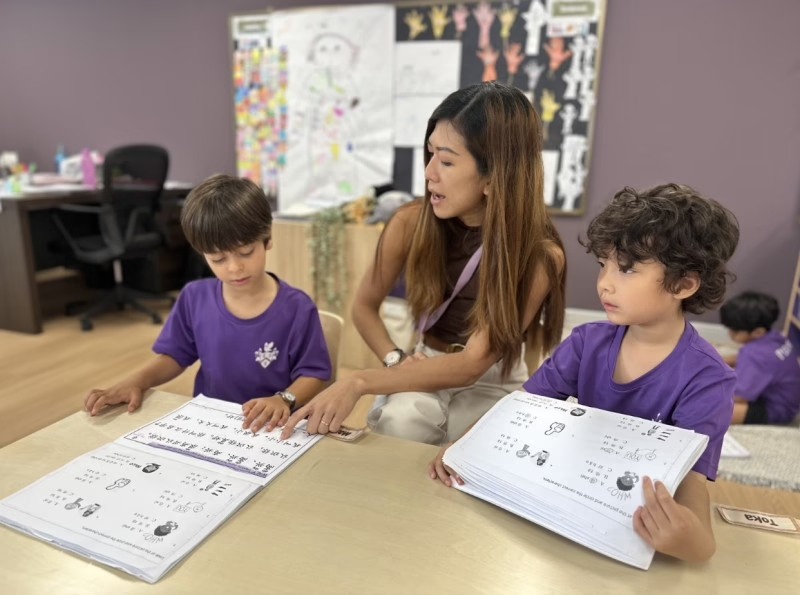
Each bilingual class is supported by both an English-speaking teacher and a Mandarin-speaking teacher. They work together to ensure children receive equal support in both languages while creating a consistent and engaging learning environment.
This collaborative approach helps children transition comfortably between English and Mandarin without feeling overwhelmed.
3. Language Learning through Everyday Experiences
Children learn best when language has purpose.
Throughout the day, they use both English and Mandarin while:
- Asking questions
- Solving problems
- Exploring new topics
- Working with classmates
- Playing and discovering
Rather than switching into “Mandarin lesson mode,” children experience both languages as natural tools for communication and learning.
4. Learning through Play and Inquiry
In the Early Years School at The Perse School (Singapore)’s, bilingual learning is supported by a play-based, inquiry-led approach.
Children explore carefully designed learning environments where they investigate, create, imagine, and collaborate.
Whether they are building structures, experimenting with water, exploring nature, or engaging in imaginative play, opportunities to use both languages arise naturally throughout the day.
This helps children develop confidence while maintaining the joy of learning.
5. Clear Bilingual Pathway Beyond Preschool
One important consideration when choosing a bilingual preschool in Singapore is what comes next.
At The Perse School (Singapore), bilingual learning continues beyond the early years.
The Chinese–English Bilingual Programme extends into the Junior School, allowing children to build on the strong language foundations they have developed during preschool rather than starting again in a different learning model.
This continuity helps children maintain their confidence and continue developing fluency as they grow.
Sample Timetable of the immersive Chinese–English Bilingual Programme at The Perse School (Singapore)
| Time/Day | Monday (English Medium) | Tuesday (Mandarin Medium) | Wednesday (English Medium) | Thursday (Mandarin Medium) | Friday (English Medium) |
| 8.30 | Start of the Day Activities | Start of the Day Activities | Start of the Day Activities | Start of the Day Activities | Start of the Day Activities |
| 9.00 | English | Mandarin | English | Mathematics | English |
| 9.50 | Mathematics | Mandarin | Mathematics | Mathematics | English |
| 10.40 | Break | ||||
| 11.00 | Science | Science | Science | Mandarin | PE |
| 11.50 | Wellbeing | Wellbeing | Phonics | Guided Reading | Assembly |
| 12.10 | Lunch | ||||
| 13.00 | Global Perspectives | Mathematics | PE | Global Perspectives | Mathematics |
| 13.50 | Coding & Robotics | Mathematics | Guided Reading | Digital Literacy | Drama |
| 14.40 | Art | Art | Music | Music | Phonics |
FAQs about The Perse School (Singapore)’s Chinese–English Bilingual Programme
- Who can join the Chinese–English Bilingual Programme?
The Chinese–English Bilingual Programme at The Perse School (Singapore) is offered from Reception onwards. Students may choose to continue in the bilingual stream as they progress into higher year levels.
- Can my child join the Chinese–English Bilingual Programme if he or she is a beginner in Mandarin?
Yes! The Chinese–English Bilingual Programme starts from the foundation level, so it is suitable for beginners in Mandarin.
- Will learning two languages affect my child’s English development?
No, learning two languages will not affect your child’s English development. Our Chinese–English Bilingual programme, which follows the 50:50 learning model, is designed to help children develop strong literacy and communications skills in both English and Mandarin. With support from specialist English- and Mandarin-speaking teachers, students build confidence in both languages simultaneously.
- Do students need to speak Mandarin at home?
No, students opting for the Chinese–English Bilingual Programme do not need to speak Mandarin at home. The programme is suitable for families regardless of the language spoken at home. Children receive consistent support in school, allowing them to develop their Mandarin naturally through daily learning and interaction.
- What makes The Perse School (Singapore)’s bilingual preschool programme different?
Our Chinese–English Bilingual Programme uses a true Two-Way Immersion approach, where children learn through both English and Mandarin on alternating days. Language learning is integrated into core subjects, play, and everyday experiences, helping students become confident communicators in both languages.
- Can my child continue bilingual learning after preschool?
Yes, students can continue in the Chinese–English Bilingual Programme as they progress into the Junior School, allowing them to build on the strong language foundation established in the early years.