

Everything You Need to Know About Choosing the Right IGCSE Subjects
What is the IGCSE?
The International General Certificate of Secondary Education (IGCSE) is one of the most well-established academic programmes in the world for students aged 14 to 16. Offered by leading examination boards such as Cambridge and Edexcel, it is recognised by schools, universities, and employers around the world. Most international schools in Singapore, including The Perse School (Singapore), offer the IGCSE.
What makes IGCSE subjects reputable is their balance of academic rigour and flexibility. Students can choose from a wide range of disciplines — from sciences and mathematics to languages, humanities, and creative subjects. This allows them to build a personalised yet well-rounded curriculum. The programme is also designed to develop critical thinking, problem-solving, and independent learning skills, which are valuable far beyond the classroom.
Because of this sturdy foundation, IGCSE subjects are often seen as a reliable stepping stone to A Level and other advanced pathways.
Why choosing the right IGCSE subjects matters
Selecting an IGCSE school and choosing IGCSE subjects are among the first meaningful academic decisions in a student’s life. While it’s important not to place too much pressure on getting every choice “perfect,” these decisions can influence future study options, including entry into top universities in the world.
For instance, certain A-Level subjects — and even university courses — may require a background in specific areas. Choosing the right combination of IGCSE subjects can help keep those pathways open.
Just as importantly, the right mix of subjects can shape a student’s day-to-day learning experience. When students feel engaged and capable in their subjects, they are more likely to stay motivated, manage their workload well, and build confidence over time.
How to choose the right IGCSE subjects

There is no single formula that works for everyone, but the following considerations can help students and parents approach IGCSE subject selection with clarity and confidence.
1. Understand the core Cambridge IGCSE subjects
In most schools, certain Cambridge IGCSE subjects are compulsory. They are typically English, Mathematics, and one or more sciences.
These core IGCSE subjects provide the essential academic foundation, so the real choice usually lies in the elective options. Understanding this can make the decision process feel more manageable.
2. Start with interests and strengths
A good starting point is to reflect on which subjects the student enjoys and performs well in.
Interest often leads to motivation, and motivation makes consistent efforts much easier to sustain. While it is healthy to take on a challenge, choosing IGCSE subjects that feel overwhelmingly difficult from the outset can make the experience unnecessarily stressful.
3. Keep future pathways in mind
It can be helpful to think ahead. For example, students considering careers in medicine, engineering, or science-related fields should usually continue with science IGCSE subjects. Similarly, an interest in business or economics may point towards Mathematics and related subjects.
However, it is perfectly normal not to have a clear plan yet. At this stage, keeping IGCSE subjects broad and balanced is often a sensible approach, as it allows students to explore different strengths and interests while keeping a wide range of future pathways open.
4. Aim for a balanced combination of IGCSE subjects
A well-rounded set of Cambridge IGCSE subjects often includes a mix of:
- Sciences
- Humanities (such as History, Geography, or Business Studies)
- Languages
- Creative or technical subjects (such as Art, Design & Technology, or Computer Science)
- Compulsory non-examined subjects
This balance helps students develop a range of skills, from analytical thinking to creativity and communication.
It is also important for students to be mindful of their workload and avoid taking on too many demanding subjects at once, as this can become overwhelming and lead to stress over time.
5. Consider different assessment styles
Not all IGCSE subjects are assessed in the same way.
Some rely heavily on final exams, while others include coursework, projects, or practical assessments. It is worth considering which formats suit the student’s learning style.
For example, students who prefer steady, ongoing work may feel more comfortable with coursework-based IGCSE subjects, while others may perform better in exam-focused subjects.
6. Speak to teachers and seek guidance
Teachers and school counsellors can offer valuable insight into IGCSE subjects — whether it is about difficulty levels, workload, or tips on coping.
Parents also play a key role in supporting discussions. However, the final decision should feel like a shared and informed one, rather than something imposed on the student.
7. Choose independently, not socially
While it is natural for students to choose the same IGCSE subjects as their friends, what works well for one student may not suit another.
Encouraging independent choices helps ensure that IGCSE subjects are aligned with individual strengths and interests, rather than social convenience.
8. Remember that flexibility remains
The most reassuring point is that IGCSE subjects do not lock students into a single path.
While they do play a role in shaping future options, there is still flexibility at A Level and beyond. Many students refine their interests over time, and education systems are designed to accommodate that growth.
The Top 3 Common Mistakes to Avoid While Choosing Your IGCSE Subjects
1. Choosing subjects based on friends
It is tempting to follow what friends are picking, but subject choices should be based on individual strengths and interests. What suits one student may not work for another.
2. Prioritising perceived prestige over interest
Some subjects are often seen as more impressive but choosing them without genuine interest can lead to low motivation and unnecessary stress. Enjoyment plays a significant role in long-term success.
3. Not seeking guidance early enough
Students sometimes make decisions without fully consulting teachers, counsellors, or parents. Early conversations can provide valuable insight and prevent avoidable mistakes.
How The Perse School (Singapore) Supports Students with IGCSE Subject Choices
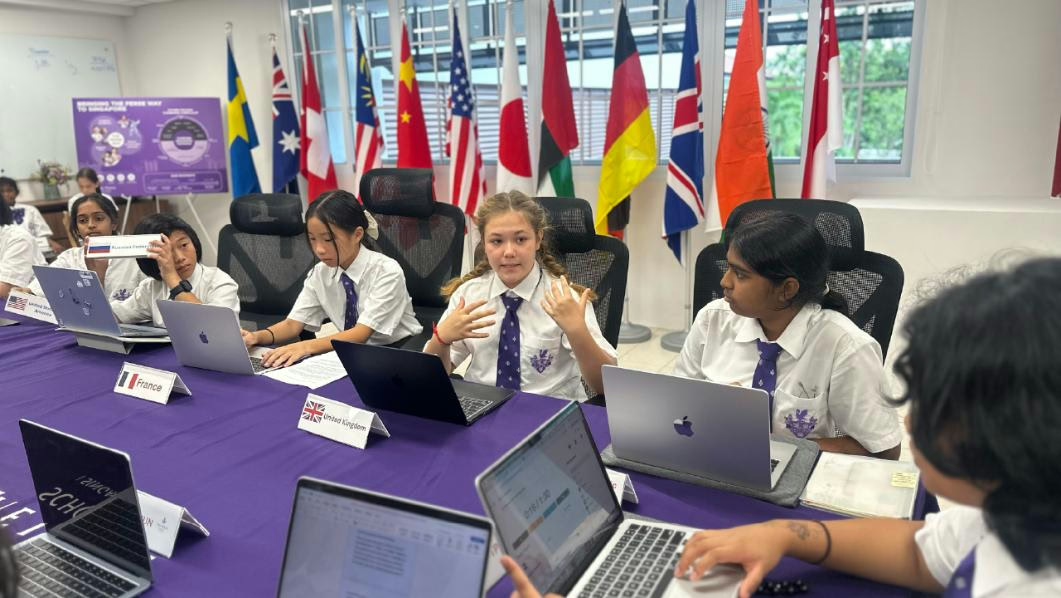
Choosing IGCSE subjects becomes a much more meaningful step with the right support and guidance.
At The Perse School (Singapore)’s Senior School, guidance around the Cambridge IGCSE subjects does not begin at the point of selection. Our IGCSE and pre-university counselling process starts as early as Year 9, giving students the time and space to reflect on their strengths, explore their interests, and make informed decisions with confidence. This early support ensures that subject choices are thoughtful rather than rushed.
In Years 10 and 11, students take the following compulsory subjects:
- English pathways
- Mathematics pathways
- Science pathways
- Foreign Language pathways
- Physical Education and Games
- Personal and Social Development
- Smart Learning Opportunities such as Critical Thinking
Additionally, IGCSE students can also choose up to two of the following subjects according to their interests:
- Art & Design
- Design Technology: Graphic Products
- Computer Science
- Geography
- History
- Business Studies
- A Third Science
Beyond academics, our approach is rooted in three-dimensional teaching, where pastoral care sits at the centre of everything we do. We recognise that choosing IGCSE subjects is not just an academic decision, but also a personal one. Students are supported not only by their teachers, but also by dedicated on-campus counsellors, ensuring they feel heard, valued, and understood throughout the process.
By combining strong academic guidance with a deep commitment to student wellbeing, we aim to create an environment where every student is equipped and supported to succeed.
To learn more about the Cambridge IGCSE pathways and Senior School experience at The Perse School (Singapore), explore our Senior School curriculum, download our prospectus, or speak with our admissions team.